
Registered nurses entering aesthetics in 2026 face a different environment than nurses who entered three years ago. Ahpra now sets minimum experience requirements before you can expand your scope into non-surgical cosmetic procedures. NSW changes its injectable administration rules again on 5 November 2026. Training that only teaches injection technique no longer prepares you for practice.
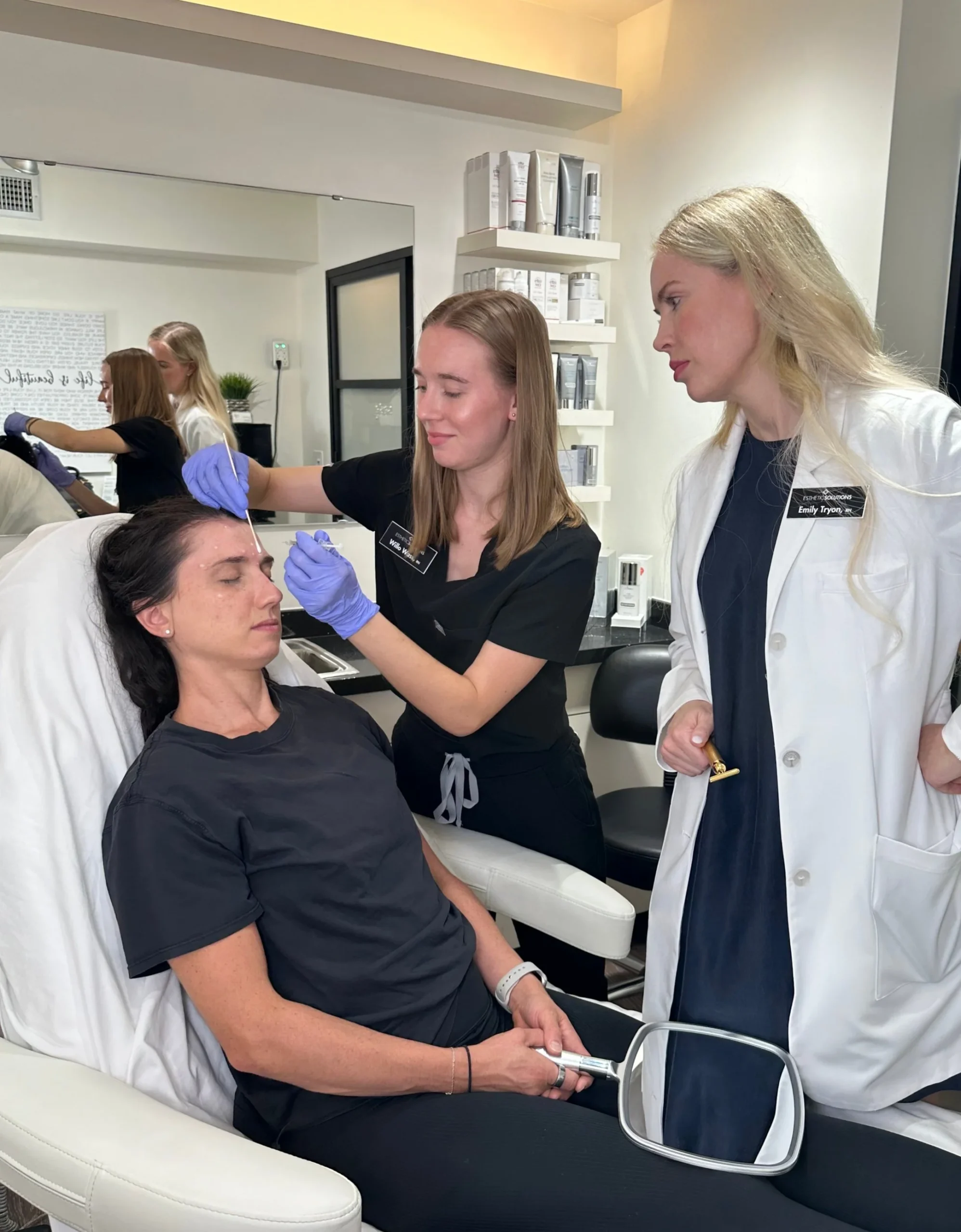
Our program is delivered in person at our Chatswood rooms and led by Dr Sana Pirzada. It covers assessment, technique, ultrasound guided anatomy, complication management and the documentation your clinic is now expected to hold.
Under the guidelines in effect since September 2025, eligibility is not a marketing decision. It is a regulatory one. This program is suited to:
If you have less than one year of general nursing experience, we will tell you so at the consultation rather than taking your enrolment. Midwives are not permitted to perform these procedures.
Training is delivered by Dr Sana Pirzada, who practises in aesthetic medicine and teaches from current casework rather than a fixed slide deck. You are taught by the person who signs off the protocols.
Facial vascular anatomy is taught with ultrasound, not diagrams. You learn to identify vessels before you inject and to detect an occlusion after.
Content is mapped to the Ahpra guidelines effective 2 September 2025 and updated for the NSW regulation commencing 5 November 2026.
Hands on sessions are capped so every participant injects under direct observation with immediate correction.

Our nurse training courses are ideal for nurses seeking hands-on experience and practical knowledge in the following areas:
Each training session combines theory with hands-on practice to ensure you gain real-world experience in a supportive learning environment.

Our cosmetic nurse training program provides registered nurses with hands-on education in advanced injection techniques under Dr. Sana Pirzada’s expert mentorship. You’ll gain the clinical expertise, anatomical knowledge, and patient safety protocols essential for excellence in aesthetic nursing while adhering to AHPRA and TGA requirements.
Vascular occlusion is the highest consequence complication in injectable practice. Ultrasound shortens the time between something going wrong and you recognising it.
Map the facial vasculature in your specific patient before the needle goes in, rather than relying on population averages.
Identify compromised flow within minutes instead of waiting for visible skin changes.
Place product at a known depth in a known plane, which improves both safety and the result.

Facial analysis, medical history, contraindication screening, photographic documentation and treatment planning. Ahpra requires an evidence based, holistic assessment before any procedure, and this module teaches you to document that assessment defensibly.
Dosage calculation, reconstitution, injection point mapping, product selection and depth. Supervised practice on live models.
Vascular occlusion recognition and response, hyaluronidase protocols, emergency equipment requirements and the escalation pathway your clinic must have in place.
You will receive guidance on career advancement, clinical branding, patient communication, and building a successful aesthetics practice.
In addition to in-clinic experience and clinical supervision, enrolling in our cosmetic nurse mentorship program offers you:
Whether you’re joining from within NSW or exploring cosmetic nurse training Sydney offerings, our courses are structured to give you an unmatched edge in the market.
Networking Opportunities with leading practitioners and like-minded professionals.
Access to continuing education resources and updates on industry trends.
Support in career planning, branding, and business development for those interested in private practice.
There is no fixed timeline. You need current registration as a nurse, at least one year of full time practice outside cosmetics, then specialised training. Most nurses complete foundational injectable training over two to four days, then build competence through supervised practice over six to twelve months.
No national accreditation system exists for cosmetic injectable training. Ahpra's guidelines do not approve, endorse or authorise specific courses, and completing one does not by itself expand your scope of practice. Responsibility for ensuring your training is adequate sits with you as the practitioner. Judge a provider on who teaches, how much supervised injecting you do, and whether complication management is covered properly.
Enrolled nurses can perform some non-surgical cosmetic procedures under registered nurse supervision, but not all. Ahpra restricts enrolled nurses from injecting dermal filler into very high risk areas such as the glabella, nose and forehead, and laser skin resurfacing requires direct registered nurse supervision.
From 5 November 2026, Part 9 of the Medicines, Poisons and Therapeutic Goods Regulation 2026 applies to eight prescription-only substances used cosmetically, including botulinum toxins, hyaluronic acid, deoxycholic acid, polylactic acid, polycaprolactone, calcium hydroxylapatite, collagen and polyacrylamide. You will only be able to administer one of these when your prescriber has authorised it for that named patient.
Our nurse training includes theory, technique refinement, and live model practice under expert supervision.
Yes. Many participants have injected for a year or more and come for ultrasound technique, complication management or help meeting the documentation expectations introduced in September 2025.
Aesthetics Consults, Suite 1101, South Tower, 1/5 Railway Street, Chatswood NSW 2067
Phone 02 8526 4838